The end of one-size-fits-all copays: Inside the rise of precision pricing and transparent episode-of-care costs in health care

For years, the copay has been a simple health insurance concept: See a primary care doctor, pay one amount. See a specialist, pay another. Get an MRI, pay a set amount.
Simple, at least on paper.
But health care itself is not always that simple. The same procedure may have very different prices depending on the provider, location, and care delivered around it. And a single episode of care could generate multiple services, providers, and bills.
This can create frustration and financial barriers to care for members. Payment complexity and lack of price transparency make it difficult to know what the grand total of a medical visit will cost, especially when it may take weeks or months for bills to arrive.
That scenario can create a disconnect between the way health care is delivered and the way members experience its cost. It also creates a copay design opportunity—
shifting the cost-sharing conversation from how much employees should pay to whether the cost can help signal the relative value of the care they’re choosing.
As employers rethink how to help mitigate rising costs while helping improve the employee experience, that disconnect is becoming harder to ignore.
Business Group on Health’s 2026 Employer Health Care Strategy Survey reveals employers are exploring nontraditional health plans—seeking increased value—and they see several promising approaches to improve quality of care, including:
- Navigation to higher-quality providers (selected by 82% of employers)1
- Greater transparency of quality data (selected by 82% of employers)1
The copay design opportunity.
Copays are among the factors driving navigation. And industry research on value-based insurance design shows copay modifications can help signal relative value.
A PubMed article states:
“Modifying copays, even in small amounts, can send signals to patients about the relative value of drugs and services. However, long-term savings will likely result from higher copays on low-value services.”2
Another PubMed article further reinforces this copay design point:
“When everyone is required to pay the same out-of-pocket amount for health care services regardless of clinical indication, there is evidence of underuse of high-value services and overuse of interventions of no or marginal clinical benefit.”3
What’s the problem with one-size-fits-all copays?
A traditional copay is designed to make cost sharing predictable. But a flat copay may obscure meaningful differences in the value of care options.3,4
The Institute of Medicine's workshop summary on value in health care described traditional cost-sharing arrangements as generally applying similar cost-sharing requirements to services despite differences in clinical value. The report noted that value-based insurance design seeks to align patient cost sharing with the relative effectiveness and value of services to encourage use of higher-value care.4
The challenge with flat copays for consumers is this: Two providers may perform the same procedure, but have different histories related to outcomes, efficiency, or cost. A tiered plan may assign both providers the same copay.
From the member’s perspective, there’s little reason to distinguish between them. The price signals they are equivalent.
That’s a limitation of a one-size-fits-all approach: It can make the cost of care easy to understand without making the value of care easy to see.
Varying copays by provider and service is one approach that may encourage members to look beyond the type of care they need and consider where and from whom they receive that care.
That is a fundamentally different role for a copay. Instead of simply assigning a financial obligation, it can become a signal.
The goal is to help make high-value care choices easier to recognize to help inform decision-making.
The other side of the problem: fragmented costs.
But copay differentiation may only solve half the problem. Another challenge is fragmentation.
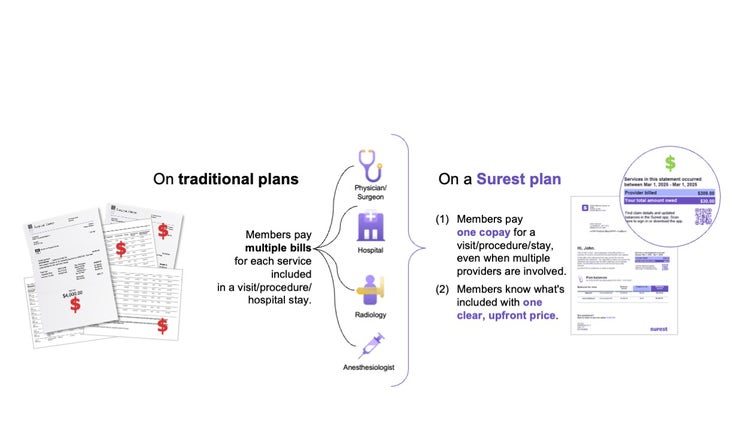
A member may schedule what feels like one episode of care, only to encounter multiple services and charges, e.g., bills for the facility, physicians, imaging, anesthesia, and more. Health care has traditionally paid providers separately for individual services, even when those services are part of the same course of treatment.
But since care happens in episodes, what if the financial experience could reflect the episode?
For consumers, this could mean moving away from a series of disconnected cost-sharing events toward a single, more predictable member responsibility for a defined course of care.
Under an episode-based cost-sharing model, the plan could instead establish one member cost for the defined episode, with the included services clearly identified in advance.
That is closer to the way consumers typically make purchasing decisions: weighing price, quality, what’s included, and other factors before choosing among options.5,6
Transparent episode-of-care costs and precision pricing: making the financial experience more predictable.
This is where fixed amounts for service categories can complement more precise copay design. The two copay approaches solve different problems.
Variable copays add precision:
They can differentiate providers, services, or treatment options based on data-backed differences in value, identified through evaluation of past performance and other factors.
Service category copays add predictability:
They can group related services into a defined episode, so members are not navigating a series of disconnected financial obligations.
Together, they help create a clearer model: Pay differently when value differs. Pay simply when care belongs together.
Helping move from “What will I owe?” to “What should I choose?”
That is a larger opportunity in modern cost sharing. A traditional plan often answers the first question only partially: What will I owe?
A consumer-oriented plan may help answer the second: What should I choose?
Those are very different experiences. The first is transactional. The second is decision-oriented.
The mission of combining variable and defined service category copays is clear costs that signal value and trade-offs when comparing choices.
What could this mean for employers?
Modernizing copays is about whether the plan’s financial architecture supports the behavior the employer wants to encourage.7
RAND Corporation research, prepared for the U.S. Dept. of Labor, reports “Cost-sharing provisions attempt to create incentives for desirable health and health care decisions. Such incentives can be part of the benefit design.
And differential co-payments based on consumer decisions on how and where to seek care can be used to steer enrollees to care options that are seen as offering improved quality and/or efficiency.”7
If the goal is:
- Higher-value care, the plan needs to make value visible3,5
- Affordability, the member should be able to see and compare their potential out-of-pocket costs before care occurs8
- A better employee experience, members should be able to understand their expected financial responsibility in advance of episodes of care8
- Consumerism, the plan needs to help people make decisions rather than simply expose them to more financial responsibility5
For the employer, the opportunity is to move beyond the traditional choices of absorbing more cost or shifting more cost. A more modern approach asks whether the plan can shape the cost experience itself.7
Enter an option for modern cost sharing.
The Surest health plan was designed to offer a simple and transparent pricing structure: variable copays tied to value, plus one copay even when multiple providers are involved.
Pricing granularity can signal value.
Surest evaluates providers to inform value-based copays, considering historical effectiveness, cost efficiency, and provider practice patterns. Rather than focusing only on unit cost, the methodology assesses complete episodes of care and the variable pricing associated with them.
Using UnitedHealthcare claims data, Surest assesses providers across a broad range of services and conditions. Related medical touchpoints and costs are considered holistically, along with plan design, to establish member cost share.
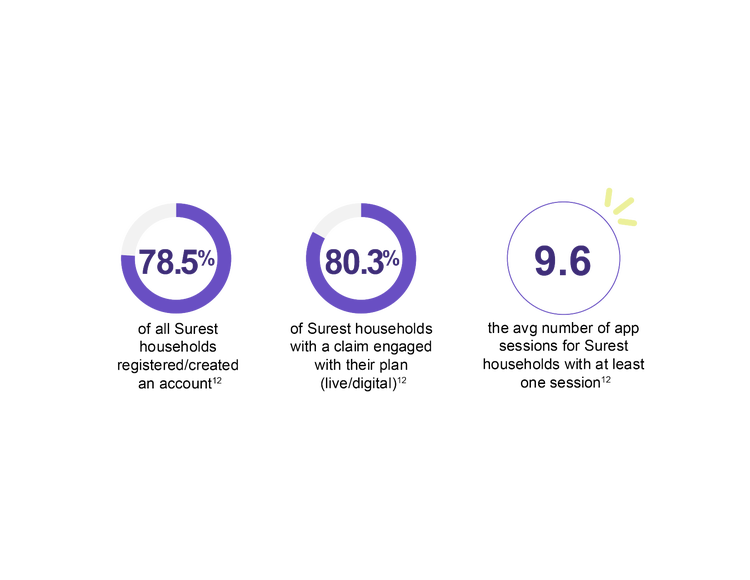
The Surest app/website is designed to provide visibility and simplicity.
On the app/website, Surest members can search, compare, and decide among care options with copays and included services visible up front.
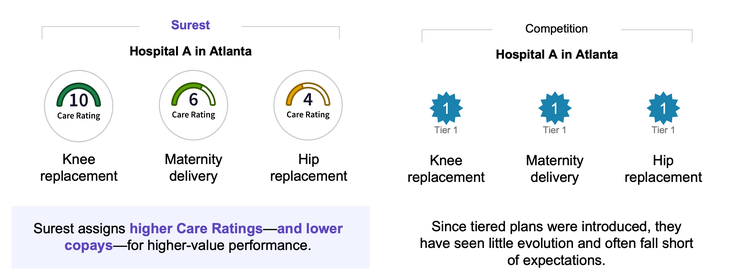
Surest varies copays by provider, service, and location. Higher Surest Care Ratings—and lower copays—are assigned to providers based on past performance, which can help to inform members’ health care choices.
Surest variable copays differ from traditional one-size-fits-all pricing, recognizing that a single location may not excel at every service.
The intersection of price and value may fuel savings.
Traditional tiered plans can group providers into broad categories, limiting how much cost and quality information consumers see when comparing individual care options.5
Conversely, Surest provider evaluation and pricing granularity can help provide meaningful value signals and potential savings.
Why this matters.
Consider a knee replacement and a hip replacement performed at the same hospital (see illustration)
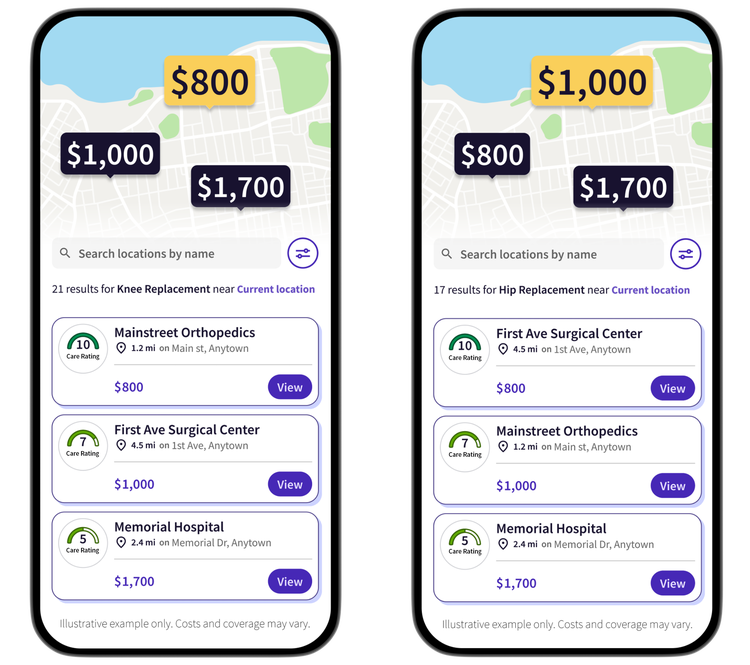
- One provider may use high-cost implants with historically longer recovery paths
- The other provider may have historically fewer complications and quicker discharge rates
While traditional plans may treat them the same—Surest differentiates.
Does price and value clarity change behavior?
With price visibility designed to be easy to understand, Surest members frequently selected lower copay options.9
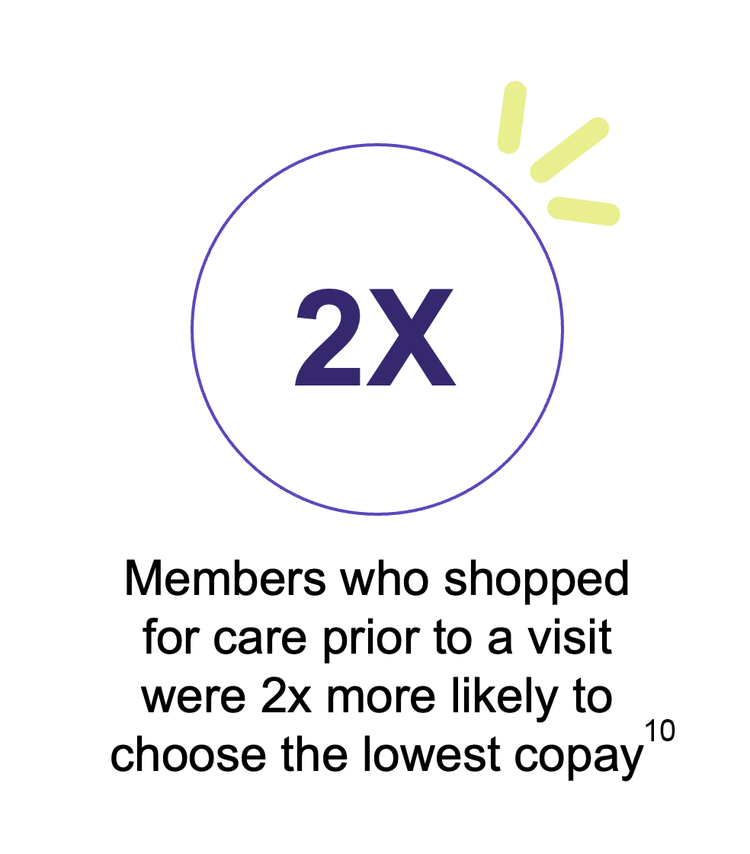
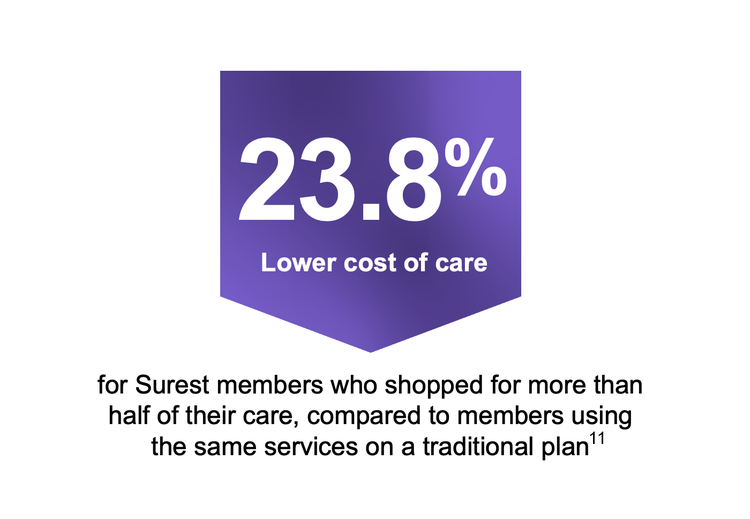
This shopping behavior is driven by Surest members’ high engagement with the app/website:
Rethinking copay and payment structure could be a double win.
A copay could be more than:
- A fixed amount attached to a service category. It can communicate value.3,5
- One line item in a fragmented billing process. It can be part of a more predictable financial experience.7
That points toward a broader redesign of cost sharing and is supported by the Surest plan design:
- More precision so differences in provider evaluations are reflected in what members pay
- More predictability so members may realize their likely financial responsibility before care7
- More simplicity so members can understand the cost of an episode of care rather than piecing together the cost of individual services 5,7
- More actionable information so price and value assessments are connected at the point of decision5
- More alignment between the experience employers want to create and the behavior their plan design can actually encourage6
Multiple industry research points cited in this article indicate the consumerism conversation requires rethinking the traditional copay. Not eliminating cost sharing. Not simply reducing it. Redesigning it so the financial experience supports more informed decisions about care, with clarity, context, predictable costs, and meaningful choices.
Check out other blog posts.
1Business Group on Health Survey: https://www.businessgrouphealth.org/newsroom/news-and-press-releases/press-releases/2026-employer-health-care-strategy-survey
2PubMed: Buttorff C, Tunis SR, Weiner JP. Encouraging value-based insurance designs in state health insurance exchanges. Am J Manag Care. 2013 Jul;19(7):593-600. PMID: 23919422.
3PubMed: Fendrick AM, Martin JJ, Weiss AE. Value-based insurance design: More health at any price. Health Serv Res. 2012 Feb;47(1 Pt 2):404-13. doi: 10.1111/j.1475-6773.2011.01358.x. Epub 2011 Dec 8. PMID: 22150718; PMCID: PMC3393011.
4Institute of Medicine. (2010). Value in health care: Accounting for cost, quality, safety, outcomes, and innovation: Workshop summary. The National Academies Press. https://doi.org/10.17226/12566.
5Sinaiko, A. D., Bambury, E., & Chien, A. T. (2021). Consumer choice in U.S. health care: Using insights from the past to inform the way forward. The Commonwealth Fund. https://doi.org/10.26099/7xbc-sb06.
6Emanuel, E. J., & Diana, A. (2021). Considering the future of price transparency initiatives—Information alone is not sufficient. JAMA Network Open, 4(12), e2137566. https://doi.org/10.1001/jamanetworkopen.2021.37566.
7Mattke, S., Van Busum, K. R., & Martsolf, G. (2014). Final report: Evaluation of tools and metrics to support employer selection of health plans. RAND Corporation. https://pmc.ncbi.nlm.nih.gov/articles/PMC5051997/
8Horný, M., Anderson, D. M., & Fendrick, A. M. (2024). Episode-based cost sharing to prospectively guarantee patients’ out-of-pocket costs. JAMA Internal Medicine, 184(6), 597–598. https://doi.org/10.1001/jamainternmed.2023.8566.
92025 Surest ASO analysis comparing utilization trends for continuously enrolled Surest members to a matched, non-Surest traditional plan control group.
102025 Surest BoB analysis comparing encounters that were shopped to encounters that were not shopped. Limited to variably priced Coverage Families.
11Surest 2025 member-level shopping and total cost of care analysis.
12Surest 2025 core classic digital engagement measurements.