Why price transparency in health care isn’t enough: What actually helps change behavior

Many people want their health care experience to be more consumer-friendly with the price transparency they see in retail transactions. But the availability of visible pricing alone hasn’t fundamentally changed how most people shop for care.1,2
Federal transparency regulations, employer demand for affordability, and growing consumer frustration around unpredictable costs have accelerated efforts to make health care pricing more visible.3,4
As a result, many transparency initiatives have increased data availability without meaningfully simplifying decision-making.6 Research suggests consumers still struggle, to use health care pricing information in ways that consistently change utilization behavior.5
The transparency challenge
One analysis published in JAMA found that among more than 140 million members across 31 health plans, only about 2% of eligible members used available price transparency tools.5 Many members were not even aware the tools existed.5
Similarly, a Peterson-Kaiser Family Foundation (KFF) Health System Tracker survey found that 85% of adults said they had not researched hospital pricing online before receiving care.4 The issue is not necessarily lack of interest in affordability. Rather, it’s that health care pricing has been difficult to interpret, compare, and act upon.
Price transparency initiatives improved the availability of cost data. But availability is not the same as usability.
KFF analyses highlight ongoing challenges with health care pricing files, including inconsistent reporting structures, duplicate pricing, mismatched provider-service combinations, and wide variation in negotiated rates.3
In some cases, hospitals have posted multiple prices for the same service with no clear explanation for the differences.6 In others, providers appear associated with services they don’t actually perform, complicating meaningful comparisons.3
Even sophisticated health care analysts have acknowledged the difficulty of interpreting the data.3 For consumers, the challenge can be even greater.
Health care pricing is rarely presented in a format that mirrors how people make purchasing decisions in other industries. Airline tickets, hotels, and retail products are typically displayed with:
- A clear total price
- Comparable options
- Visible tradeoffs
- Consumer reviews or quality indicators
- A clear path to purchase
Health care pricing information is often difficult to compare, interpret, and act upon, even when it’s publicly available.6,7,9
Instead, consumers may encounter:
- Estimated rather than assigned copays
- Complex billing terminology
- Facility-only pricing (i.e., hospital facility charge but not costs of providers such as surgeon, anesthesiologist, radiology, imaging, etc.)
- Broad provider tiers
- Disconnected navigation experiences
- Unclear differences between providers
Even when transparency tools are offered, many consumers still do not know what they will ultimately owe out-of-pocket (OOP).6 According to KFF’s Survey of Consumer Experiences with Health Insurance:
30% of adults said it was difficult to understand how much they would pay OOP when using their insurance.6
This complexity creates an important distinction: Displaying prices is not the same as increasing confident health care shopping.
What may actually change behavior
Research suggests transparency becomes more effective when paired with simplicity, incentives, and actionable guidance.5
A study published in the American Journal of Health Economics examined how Safeway grocery employees responded to price transparency tools combined with reference pricing for lab and imaging services.5
During the first year, employees were offered transparency tools alone. Consistent with previous studies, researchers found that members rarely shopped for lower-cost care.5
But in the second year, reference pricing was introduced alongside the transparency tools. Employees who selected providers above a defined reimbursement threshold paid the difference out-of-pocket.5
Behavior changed.

The implication was significant: Transparency alone had limited impact, but transparency combined with meaningful incentives and clear tradeoffs influenced decision-making.5
This finding aligns with broader consumer behavior patterns across industries. People may be more likely to engage when experiences are: 1,2,5
- Simple
- Immediate
- Personalized
- Easy to compare
- Actionable at the point of decision
Health care is no exception.
For brokers, consultants, and employers, that raises an important strategic question:
Does a health plan merely display copays, or does it actively help members make informed decisions?
The difference matters.
Static estimates and machine-readable files may satisfy regulatory requirements, but they do not necessarily create a consumer-oriented experience.
A new generation of health plan design
More advanced plan designs embed price and value signals directly into the member journey itself. Rather than relying on broad network tiers or generic navigation tools, the Surest health plan offers provider-level and service-level variable copays designed to reflect historical performance, efficiency, and value.
Instead of showing estimated costs after a complicated search process, the Surest app and website display actual copays in advance of care through a digital shopping-style experience.
Surest Care Ratings assess provider services based on past effectiveness and cost-efficiency. Providers evaluated as high value receive lower copays, which may help create clearer trade-offs between cost and value at the point of decision.
That difference becomes important in situations where traditional plan designs may treat providers similarly despite meaningful differences in outcomes or efficiency.
For example, two orthopedic surgeons at the same hospital may perform the same procedure but have different historical patterns related to complications, recovery time, or cost efficiency. Traditional broad-tier pricing may not distinguish between them—a more precise consumer-oriented pricing model can.
This type of design aims to help reduce cost friction rather than requiring members to independently interpret fragmented pricing data.
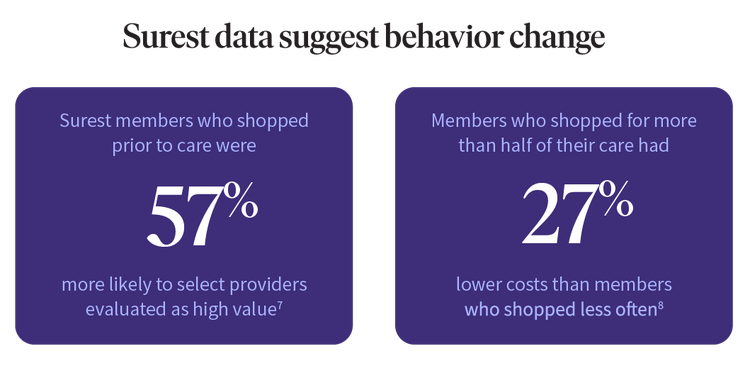
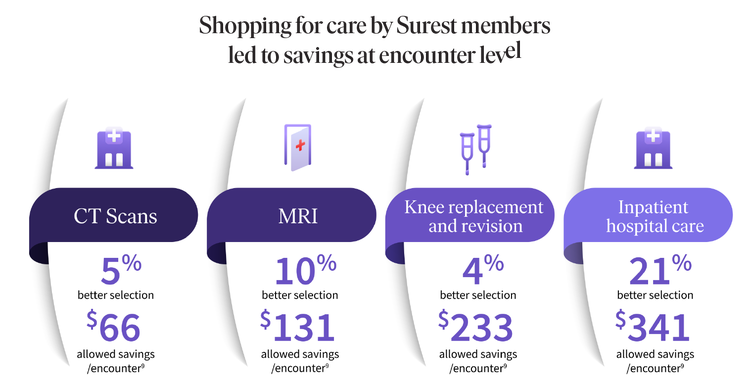
Industry research reinforces the behavior seen among Surest members when care and cost options plus value data are provided. An industry report titled “Cost Transparency and Consumer Behavior—An Analysis of Consumer Responses to Pricing” found:
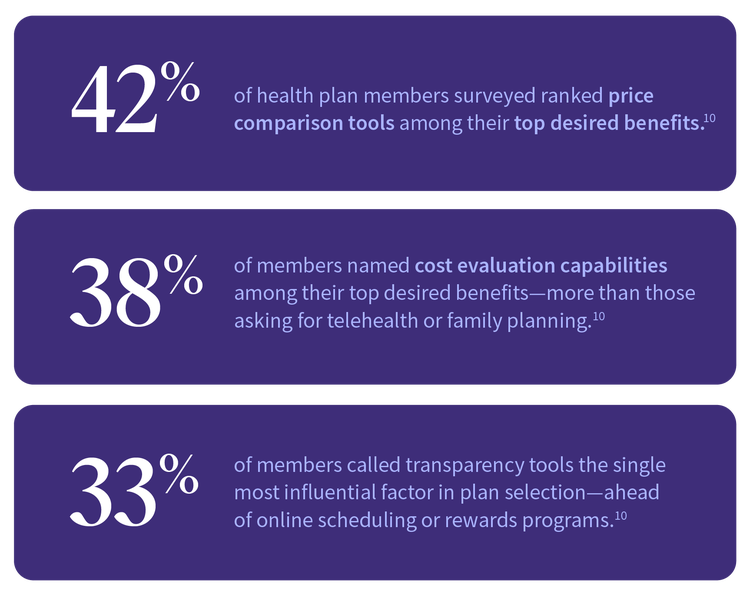
These findings support a broader industry lesson: Health care consumerism and behavior change are less about making price data available and more about making decisions easier.
Transparency alone does not automatically create a functioning consumer market. It requires experiences that combine:1,2,5,3,5
- Understandable pricing
- Effectiveness and value signals
- Navigation support
- Simpler digital experiences to help inform decisions before care occurs
What employee health benefits leaders should look for
For brokers, consultants, and employers evaluating the next generation of health plans, the more important question may no longer be:
“Does the plan offer transparency?”
Instead, it may be:
“Does the experience actually influence behavior?”
That distinction could determine which health plans merely expose health care complexity and which ones may help consumers successfully navigate it.
Ready for a change? See how the Surest plan is leading the way.
Check out other blog posts.
1PwC, US Healthcare Consumer Insights Survey (2025).
2McKinsey & Company, Capturing Growth with a Consumer-Centric Healthcare Experience (2024).
3Kaiser Family Foundation, Challenges with Effective Price Transparency Analyses (Feb. 25, 2025).
4KFF Health News, Hospital Prices Must Now Be Transparent. For Many Consumers, They’re Still Anyone’s Guess (July 22, 2021)
5JAMA Network, Price Transparency in Health Care Has Been Disappointing (Aug. 22, 2019)
6Kaiser Family Foundation, Survey of Consumer Experiences with Health Insurance (2023).
7Surest 2024 book-of-business YTD.
8Surest 2025 member-level shopping and total cost of care analysis.
92025 Surest ASO analysis comparing provider selection trends for continuously enrolled Surest members to a matched, non-Surest traditional plan control group.
10Zelis, Cost Transparency and Consumer Behavior: An Analysis of Consumer Responses to Pricing (2026)